Here's what actually mattered this week.
This Week's Big Stories
1. The Economy Slowed. Inflation Didn't. Here's What That Means.
The two economic reports that mattered most this week landed within days of each other and pointed in opposite directions.
Q4 GDP came in at 1.4%, a sharp miss against expectations of 2.5%. Growth is slowing. At the same time, core PCE, the Federal Reserve's preferred inflation gauge, hit 3% year-over-year in December, its highest reading since early 2025 and above what economists projected. Inflation is not slowing. When you get both of those readings in the same week, it puts the Fed in a genuinely difficult position.
The FOMC minutes released on February 18th reflected exactly that tension. Officials held rates at 3.5–3.75% and signaled a pause on further cuts. Some members went further, raising the possibility of hikes if inflation stays sticky. Markets had priced in a comfortable cutting cycle through 2026. That picture looks less certain now.
Into this, Trump nominated Kevin Warsh to replace Jerome Powell when his term ends in May. Warsh built his reputation as a hawk, someone focused on fighting inflation above all else. But since his name surfaced as a frontrunner, his public positioning has shifted noticeably toward cuts. Trump has been explicit that willingness to cut rates is a condition of the job. The message to anyone who wants the chair is not subtle.
Why does the Fed chair matter for Bitcoin? Because the direction of monetary policy determines how many dollars exist. A Fed that cuts rates faster than economic conditions justify, whether because of political pressure or otherwise, is a Fed that expands the money supply. More dollars in circulation means each one buys a little less. That erosion is slow, quiet, and invisible on your bank statement. Your balance goes up while your purchasing power goes down.
Historically, periods of loose monetary policy have coincided with significant Bitcoin price appreciation, as people seek assets with a fixed supply. But beyond the price, this is the structural argument. Rules that do not change, set by no one, beholden to nothing. 21 million coins. Always.
2. The Tariffs Were Struck Down. New Ones Were Signed That Same Evening.
On February 20th, the Supreme Court ruled 6-3 that Trump's sweeping import tariffs were unconstitutional. The court found that IEEPA simply does not give the president authority to levy tariffs. It was a significant legal rebuke of the administration's core trade strategy.
By that evening, Trump had signed a new executive order imposing a 10% global tariff under Section 122, a separate and largely untested legal authority. Treasury Secretary Scott Bessent followed up with assurances that the administration would supplement it with Section 232 and Section 301 measures. His bottom line: tariff revenue in 2026 will be "virtually unchanged." The legal durability of these new mechanisms is unclear and will almost certainly face its own court challenges, but the intent is plain. The tariffs are staying, just under different legal clothing.
The part that tends to get lost in the legal back-and-forth: the cost does not stay at the border. Tariffs are a tax on imports, and like most taxes on businesses, the real cost gets passed to the consumer. The person paying more is not the foreign manufacturer. It is you, at the register. That is true regardless of which statute they are imposed under.
Markets expressed relief on Friday despite the GDP miss and hot inflation print. US stocks remain near all-time highs. Whether that confidence reflects a genuine read on the economy or a market that has simply decided to look past the data for now is worth watching. The combination of slowing growth, sticky inflation, and a trade policy still very much in flux is not a backdrop that typically rewards complacency.
3. The Story Nobody Was Talking About: Lightning Just Crossed $1 Billion
While the price charts dominated the conversation this week, Bitcoin developers kept building. According to data published by River in mid-February, the Lightning Network processed an estimated $1.17 billion in November 2025, its first month above $1 billion and roughly 400% higher than November 2024. The average transaction size grew from $118 to $223.
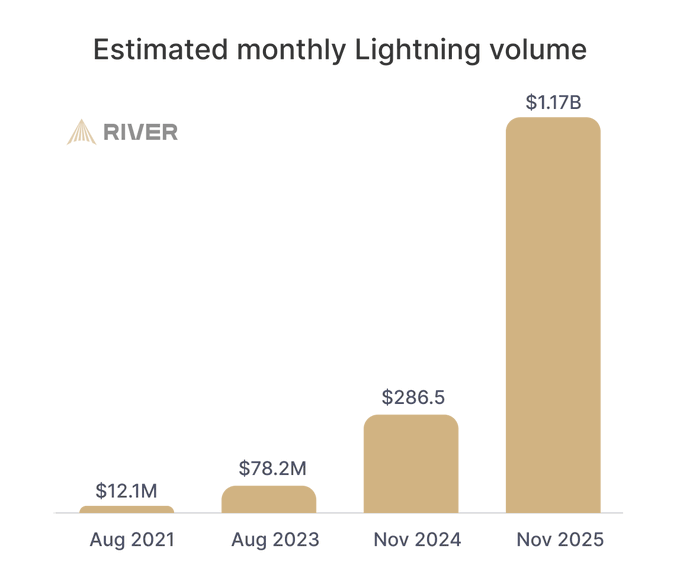
It is worth being precise about what is driving that volume: the dominant use case today is transfers between exchanges, not everyday purchases at the register. That is a more modest story than the headline suggests, but it is still a meaningful one. Exchange-to-exchange settlement over Lightning is faster and cheaper than traditional rails, and the infrastructure being built for that use case is the same infrastructure that enables everyday payments as adoption grows.
If you are not familiar with Lightning: Bitcoin's base layer is designed for security and finality above everything else. It processes transactions slowly and deliberately, prioritizing the integrity of the ledger. The Lightning Network is a second layer built on top of it, a network of payment channels that allows people to send Bitcoin instantly and at near-zero cost, without recording every transaction on the main blockchain. Think of it as a tab you run throughout the day that settles at the end of the night. Bitcoin's base layer handles the settlement. Lightning handles the everyday movement.
The $1 billion milestone reflects real, growing use. Layer 2 infrastructure is at all-time highs even as the price sits well off its peak. The network does not wait for the market to recover. It just grows.
For a full breakdown of how the Lightning Network works, channels, routing, fees, and real-world use cases, read our dedicated explainer: What is Bitcoin's Lightning Network?
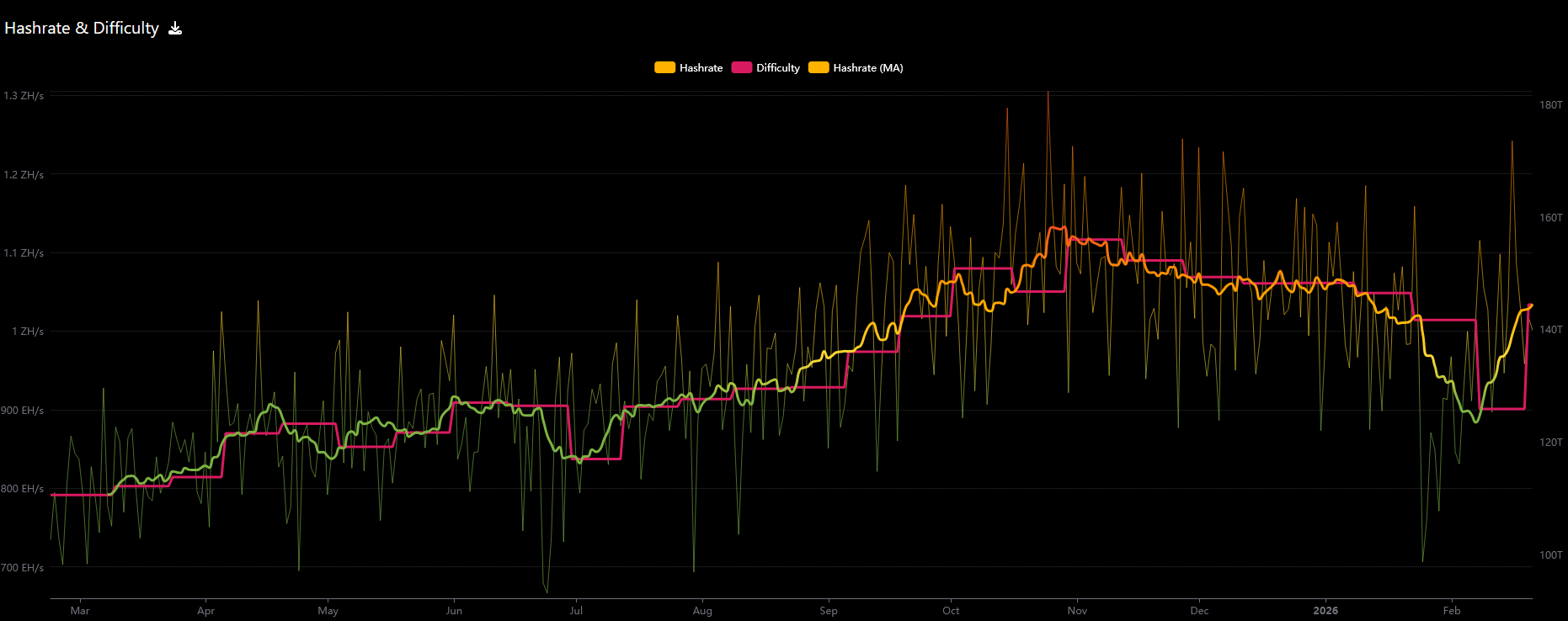
What it means: A severe US winter storm knocked roughly 200 EH/s of mining capacity offline in early February. Once conditions cleared, miners reconnected and the network self-corrected with a record adjustment. It took the entire Bitcoin network over 11 years to reach 15 trillion in total difficulty. This single two-week adjustment added 18.5 trillion.
4. On the ETF Headlines: What They're Actually Saying
The iShares Bitcoin Trust, BlackRock's ETF and the largest in the world, has seen approximately $2.8 billion in net outflows over the past three months. That number is real. What the headline version leaves out: net inflows over the full year since launch total approximately $62 billion, and total assets under management across all U.S. spot Bitcoin ETFs sit over $110 billion.
And while some institutions were trimming, others were quietly adding. Jane Street raised its IBIT stake by 54% in Q4 2025, adding 7.1 million shares worth $276 million to bring its total position to approximately $790 million, making it the fourth-largest IBIT shareholder. Goldman Sachs disclosed roughly $2.36 billion in total crypto exposure, including a $1.1 billion IBIT position. Morgan Stanley and Barclays both increased their positions as well. Worth noting on Jane Street specifically: as a designated market maker and authorized participant for IBIT, part of their holding is operational, maintaining inventory to support share creation and redemption. But the direction of the position still tells you something.
The analysts who track this closely are drawing a distinction between who is selling. Hedge funds and short-term speculators rotate out when volatility spikes. That is what they do. Long-term holders, particularly retail investors who came in through ETFs as a portfolio allocation, are largely sitting still. Paper loss and panic selling are different things, and most of the data so far suggests the latter has not started.
ETF outflow headlines describe the behavior of fast money. They do not describe the structural position of the asset.
Even with the price still depressed, adoption continues to grow. As short-term price pain arrives, this feels like any other dip. Bitcoin is not broken, dead, or afraid. It just changes hands. Layer 2 infrastructure and usage are at all-time highs. Hashrates are rebounding sharply. And Bitcoin's core thesis has not changed. Amidst the price noise, the political uncertainty, and the economic headwinds, Bitcoin grows.
See you next Saturday.